
Paulista Agreement Opens New Round for ICMS Tax Debt Settlement with Discounts and Extended Payment Terms
Applications may be submitted until December 18. The terms include discounts of up to 100% on interest and penalties, payment in up to 145 installments, and the use of accumulated ICMS tax credits and court-ordered payment claims (precatórios).
The São Paulo State Attorney General’s Office (PGE/SP) has published two new notices under the Paulista Agreement (Acordo Paulista) for the settlement of ICMS tax debts registered as overdue state tax liabilities. Applications must be submitted electronically by 11:59 p.m. on December 18, 2026.
Available Settlement Options
Notice No. 01/2026: Covers ICMS tax debts registered as overdue state tax liabilities and establishes different terms according to the degree of recoverability assigned to each debt by the PGE/SP and the down payment percentage selected.
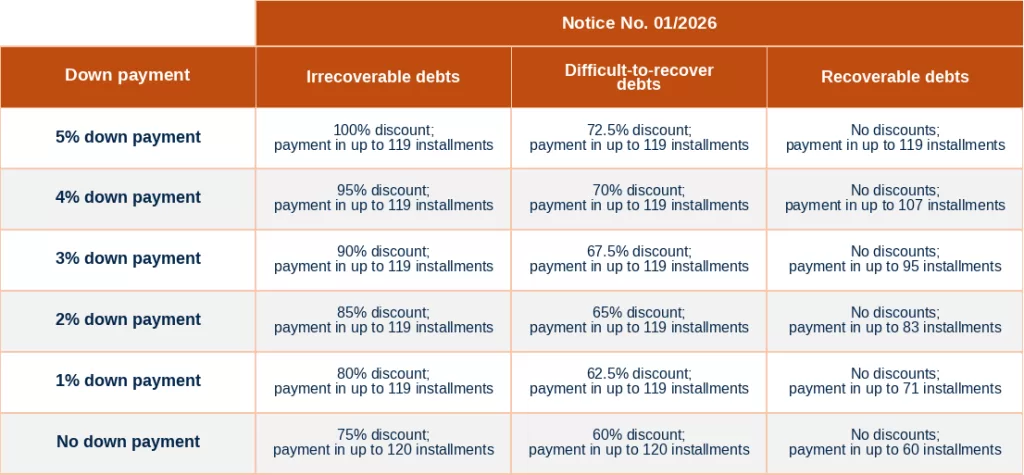
Discounts may reach 100% of interest and penalties, subject to an overall limit of 65% of the total amount of the debts being settled. Discounts do not apply to the principal amount or standalone penalties.
Taxpayers classified as systematic defaulters will not be eligible for discounts. In such cases, the terms applicable to recoverable debts will apply.
By accepting Notice No. 01/2026, taxpayers agree to the degree of recoverability assessed by the PGE/SP and waive the ordinary procedure for reviewing that classification. Accordingly, the rating assigned to the debts and its financial implications should be carefully assessed before acceptance.
Debts already included in a previous settlement, ordinary installment plan, or special installment plan cannot be transferred to Notice No. 01/2026, even if the existing agreement is in good standing.
Notice No. 02/2026: Intended for companies undergoing judicial reorganization, liquidation, or bankruptcy. The terms vary according to the down payment percentage and are independent of the individual classification assigned to the debts.
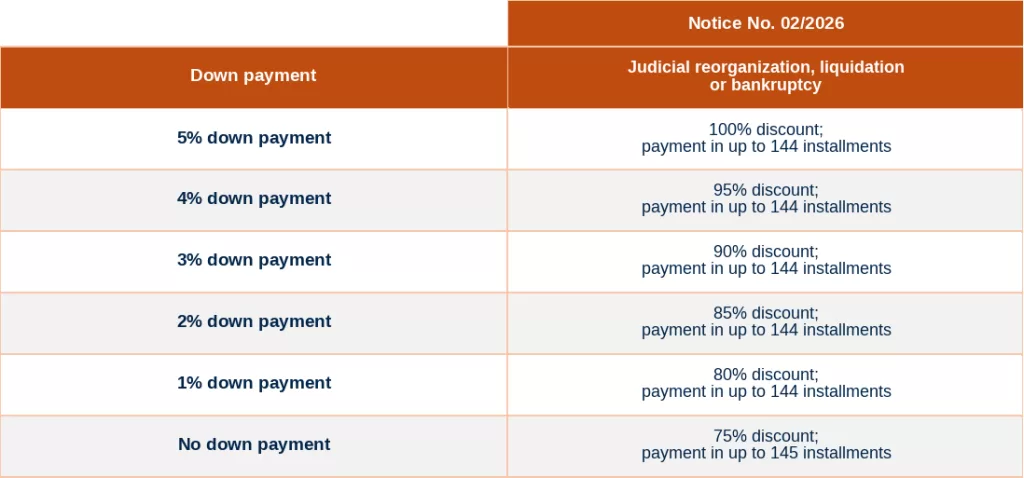
Under this option, the reduction may not exceed 70% of the total amount of the debts being settled, nor may it apply to the principal amount or standalone penalties.
Notice No. 02/2026 allows taxpayers to transfer existing installment plans and settlement agreements. However, installments already paid will count toward determining the maximum term of the new agreement, with no refund or reimbursement of amounts previously paid.
Which Debts May Be Included?
Both notices exclusively cover ICMS tax debts registered as overdue state tax liabilities in the State of São Paulo. Taxpayers may select the debts they wish to settle, subject to the following rules:
- Each Certificate of Overdue Tax Liability (Certidão de Dívida Ativa – CDA) must be included in its entirety and cannot be split;
- If debts are grouped under the same tax enforcement proceeding, all corresponding CDAs will be automatically included as an inseparable set;
- As a general rule, each application may cover up to 50 CDAs; and
- The presence of an ineligible debt within a given group may prevent all debts in that group from being included.
Among other exclusions, the following debts cannot be included: ICMS surcharges allocated to the State Fund for Combating and Eradicating Poverty (FECOEP), debts not registered as overdue tax liabilities, and debts owed by taxpayers whose previous settlement agreements were terminated within the last two years.
Use of ICMS Tax Credits and Court-Ordered Payment Claims (Precatórios)
Duly approved accumulated ICMS tax credits and eligible court-ordered payment claims (precatórios), whether held by the taxpayer or acquired from third parties, may be jointly used to offset up to 75% of the outstanding balance calculated after discounts.
The use of these assets is not automatic. Accumulated ICMS tax credits require an application to the Settlement Unit (Núcleo de Transação) and approval by the São Paulo State Department of Finance and Planning. Precatórios, in turn, require the prior execution of a set-off agreement, the issuance of a Certificate of Available Net Amount (Certidão de Valor Líquido Disponível), and the reservation of the relevant credit.
Accordingly, taxpayers interested in these alternatives should begin the document review and the applicable procedures well in advance.
Review of Tax Penalties
After acceptance and payment of the down payment or first installment, and still within the application period, taxpayers including debts arising from a Tax Assessment and Penalty Notice (Auto de Infração e Imposição de Multa) may file an administrative request to adjust the penalties to the limits established under Article 113-A, Paragraph 1, of the National Tax Code (Código Tributário Nacional – CTN).
The request does not suspend installment due dates. If granted, the outstanding balance will be recalculated and redistributed among the remaining installments, with no refund or offset for any amounts previously overpaid.
Litigation, Guarantees and Attorneys’ Fees
Entering into a settlement entails an irrevocable and unconditional acknowledgment of the debts included. Taxpayers must withdraw administrative objections and appeals and waive the rights asserted in lawsuits, objections to tax enforcement proceedings, and appeals relating to the same debts.
No new guarantees will be required for enrollment. However, existing guarantees must be maintained and, where established in proceedings seeking to challenge tax collection or in precautionary proceedings, may be transferred to the corresponding tax enforcement proceeding.
Attorneys’ fees assessed in tax enforcement proceedings are included in the settlement amount and will be reduced in the same proportion as the discounts granted on interest and penalties. No reduction will apply to debts that have not yet been subject to judicial enforcement.
Any prevailing-party attorneys’ fees payable in objections to tax enforcement proceedings or lawsuits brought to challenge the debts must be paid separately, in the amount established by the court or, where no amount has been determined, at the minimum rates set forth in Article 85, Paragraph 3, of the Brazilian Code of Civil Procedure.
Transferring Existing Agreements Requires Careful Assessment
Under Notice No. 02/2026, electronic acceptance automatically terminates any ongoing installment plans and settlement agreements relating to the same debts, even if the new settlement is ultimately not executed. In such circumstances, the previous agreements will not be reinstated.
Accordingly, any transfer should be preceded by a detailed comparison between the cost of the existing agreement and that of the new settlement, taking into account discounts, remaining payment terms, guarantees, future interest charges, and payment capacity.
What Should Be Assessed Before Applying?
The decision should not be based solely on the nominal discount percentage. Taxpayers are advised to assess:
- The recoverability classification assigned to each debt;
- The discount that can effectively be obtained, considering the overall 65% or 70% cap;
- The payment term and financial cost of installments adjusted monthly by the Brazilian Central Bank’s Reference Interest Rate (Selic);
- Whether it is advantageous to maintain or withdraw administrative and judicial disputes;
- Prevailing-party attorneys’ fees and existing guarantees;
- The possibility and timing of using accumulated ICMS tax credits or precatórios;
- Whether tax penalties may be adjusted to the limits established under the CTN; and
- Under Notice No. 02/2026, the irreversible consequences of transferring existing settlement agreements.
The Tax team at Araújo e Policastro Advogados is available to assess the eligibility of tax debts, review the recoverability classifications assigned by the PGE/SP, simulate payment scenarios, and assist taxpayers with the procedures required for enrollment and the use of accumulated ICMS tax credits or precatórios.

Fernanda Botinha Nascimento – fnascimento@araujopolicastro.com.br

Vanessa Cuachio Lourenço – vlourenco@araujopolicastro.com.br