
A New Milestone in the Granting of Legal Aid Benefits: The STF’s Ruling in ADC 80 and What This Means for Companies and Workers
On September 3, 2026, the Plenary Session of the Federal Supreme Court (“STF”) concluded its ruling on the merits of Declaratory Action of Constitutionality No. 80 (“ADC 80”), establishing a new legal framework for the granting of legal aid, with effects that extend beyond the Labor Courts to encompass all branches of the Judiciary.
Before 2017, the granting of legal aid in labor courts was broad; a simple declaration of poverty was sufficient, with no objective income threshold. The Labor Reform (Law No. 13,467/2017) changed the legal criteria, requiring proof of insufficient resources from those earning more than 40% of the ceiling for the General Social Security System (“RGPS”), which currently amounts to more than R$ 3,390.22*.
However, the Superior Labor Court (“TST”), by applying Precedent No. 463, I, effectively maintained the almost automatic granting of legal aid, a practice that was widely followed in the labor courts.
In December 2024, the Superior Labor Court (TST) itself issued Precedent No. 21, a binding ruling that, while reaffirming the requirement to provide proof for those earning more*, also established that the benefit would be granted automatically and without further question to those earning up to that limit.
To understand the true scope of this change, it is helpful to briefly review how this issue has evolved:
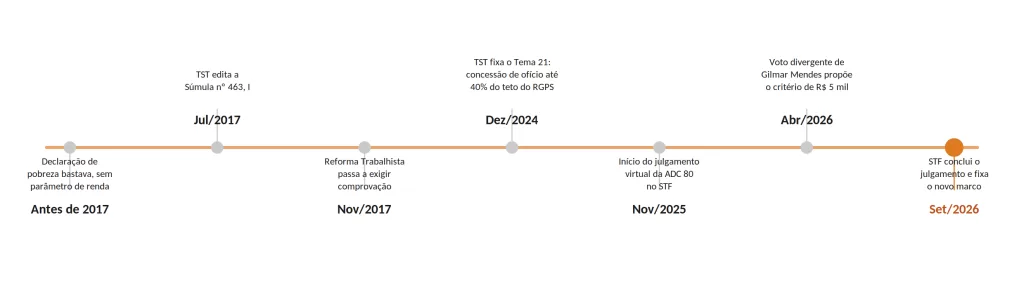
It was against this backdrop of tension between the law and case law that the National Confederation of the Financial System (Consif) filed a petition with the Federal Supreme Court (STF), initiating, in November 2025, the hearing of ADC 80, which included a dissenting opinion by Justice Gilmar Mendes, in April 2026, proposing an objective threshold of R$5,000—an interpretation that ultimately prevailed in the ruling on the merits concluded in September 2026.
In summary, the new rules established by the STF replace the old approach—which relied solely on a simple declaration—with objective income criteria, while allowing for a concrete assessment of each applicant’s economic situation. The main criteria and restrictions for granting legal aid are now as follows:
① Income up to R$ 5,000: a relative presumption of insufficient resources, waiving the requirement for documentary proof, unless challenged with evidence to the contrary;
② Income above R$ 5,000: Individualized, documented proof of insufficient resources is now required; a simple declaration is no longer sufficient;
③ Asset review : Regardless of income level, the judge may assess the applicant’s assets and family income and deny the benefit, even to those who fall within the income limit; and
④ Adjustable threshold : The R$ 5,000.00 aligns with the income tax exemption threshold (Law No. 15,270/2025) and is adjusted annually or, in the absence of an adjustment, based on the IPCA.
Although the effects have been in force—pursuant to the amendment—since the publication of the trial minutes on September 11, 2026, without retroactive effect on cases already filed, the decision has not yet become final.
This means that the ruling may undergo editorial adjustments or specific clarifications in response to any motions for clarification, without altering its essence—the R$5,000 threshold and the end of the absolute presumption.
For firms that specialize in defending against labor claims, the ruling has practical implications and opens up concrete opportunities:
| Impact / Opportunity | What this means in practice |
| Reduction in Litigation | With the end of the automatic presumption for cases exceeding R$ 5,000, the number of lawsuits and requests for legal aid without a real economic basis is likely to decrease, thereby discouraging opportunistic litigation. |
| Reasoned Objection | The defense is now able to challenge the grant of legal aid on a more substantive basis, by pointing to the lack of evidence of insufficient financial resources, rather than merely making generic allegations against the claimant’s statement. |
| Attorneys’ fees, expert witness fees, and court costs | Stricter criteria for granting legal aid tend to reinforce the enforceability of attorneys’ fees in cases dismissed or decided in part in favor of the opposing party, in addition to court costs and expert witness fees. |
| Attention: TST Topic 21 | Those who currently earn up to R$3,390.22 (40% of the RGPS ceiling) will continue to receive benefits almost automatically; the defense strategy should focus on claimants with incomes above the new threshold of R$5,000. |
Nevertheless, it is prudent to continue monitoring any developments regarding ADC 80 over the coming months, before the new interpretation becomes final—particularly with regard to its adoption by the Labor Courts.
The Labor Law Team at Araújo e Policastro Advogados is available to answer any questions.
Authors:

Ana Lúcia Pinke Ribeiro de Paiva – apinke@araujopolicastro.com.br

Marcos Rafael Carneiro – mcarneiro@araujopolicastro.com.br